
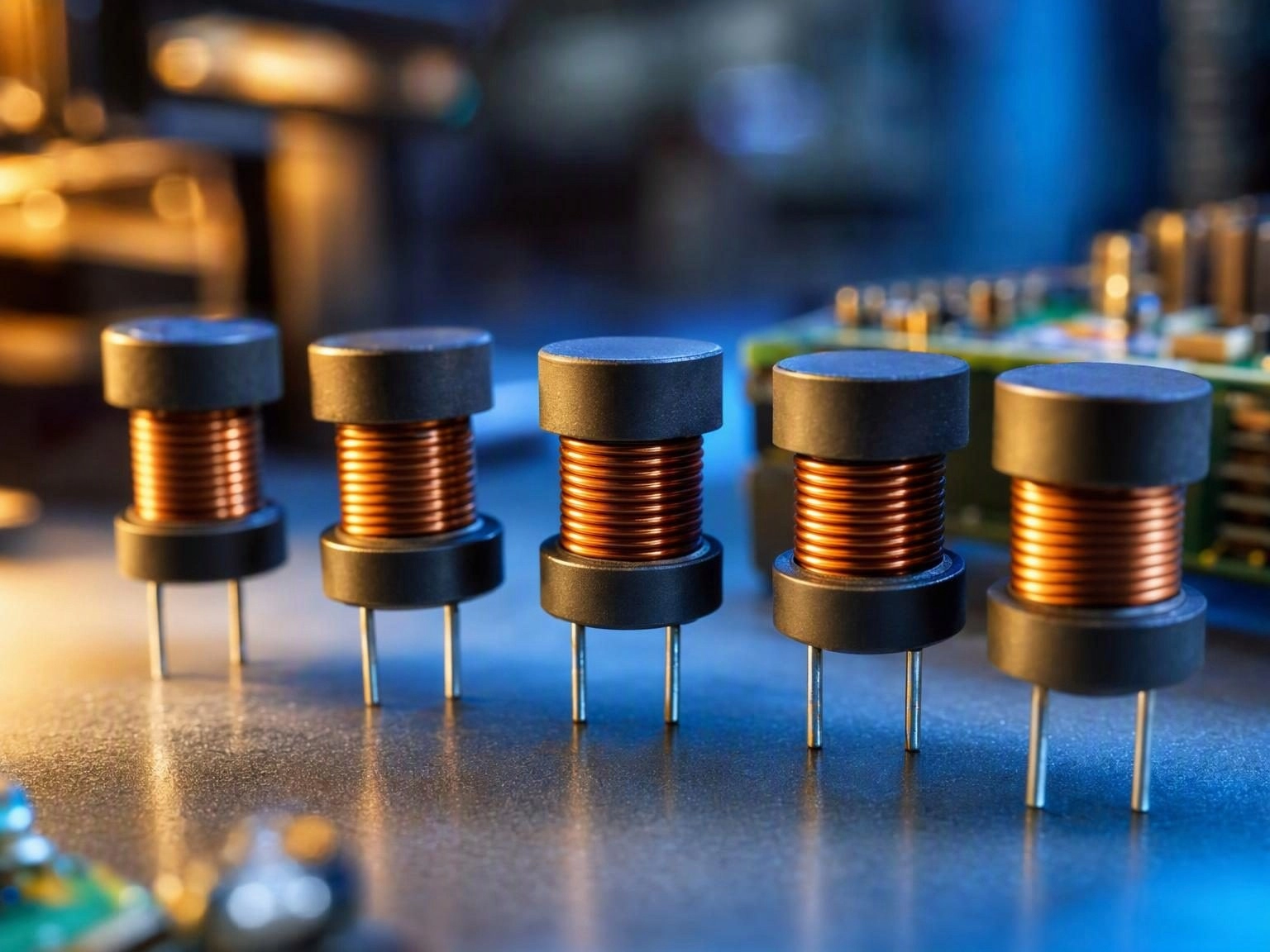
Construction and Why It Matters
A drum core inductor consists of a spool shaped ferrite core with a radial winding and either axial or radial leads. The open magnetic path means the core does not fully enclose the winding, so the inductor radiates more flux than a toroidal or shielded design and its inductance is more sensitive to nearby conductive material. In exchange, the construction is simple, cheap to produce and easy to automate, and it handles current well for its size.
Quality Factor and Self Resonant Frequency
The drum core geometry produces relatively low winding capacitance, which pushes the self resonant frequency high and yields good quality factor across a broad band. That is why these inductors appear in tuned circuits and filtering as well as in power conversion. The trade off is that the open path reduces effective permeability and permits more flux leakage.
In power applications the self resonant frequency matters because it defines where the inductor stops behaving like an inductor entirely.
Saturation Current Versus Rated Current
Two current figures appear on most datasheets and they are not interchangeable. Rated current usually describes the DC current that produces a specified temperature rise, typically around 40 degrees Celsius, and is limited by copper loss. Saturation current describes the point where inductance has fallen by a defined percentage, commonly 10 or 20 percent, and is limited by the core.
A converter needs the inductor to stay above a minimum inductance at peak current while keeping the winding cool at RMS current. Both figures must be checked against the actual waveform, which in a buck stage is a DC current with a triangular ripple rather than a pure DC value.
Typical Applications
- Buck and boost DC to DC stages in consumer electronics
- Power filtering and supply decoupling in set top boxes and displays
- Audio equipment where quality factor and linearity matter
- LED driver stages that require moderate current with tight cost targets
- Industrial control boards that tolerate the open magnetic path
When to Choose a Shielded Alternative
If the board has adjacent sensitive circuitry, if EMI limits are tight, or if the inductor sits close to a metal chassis, the leakage flux of a drum core can become a problem. In those cases a shielded drum core with a ferrite sleeve or a moulded shielded inductor is the better answer, at higher cost and often lower current rating for the same footprint.
We manufacture through hole drum core inductors in a range of standard sizes with inductance values and current ratings matched to common DC to DC stages, and can tune the winding for a specific ripple requirement.