The Four Parameters That Decide Everything
Every core material is a compromise among permeability, saturation flux density, loss and cost. Permeability determines how much inductance you get for a given number of turns and core volume. Saturation flux density determines how much current the core can carry before inductance collapses. Loss determines how much heat the core generates at a given flux swing and frequency. Cost determines whether any of it is commercially viable.
Manganese Zinc Ferrite
MnZn ferrite offers the highest permeability of the common materials and low loss over a wide frequency range, which makes it the default for transformers and for inductors where DC bias is modest. Its weakness is abrupt saturation. Once flux density reaches the material limit, inductance falls away very quickly. That is manageable in transformers but dangerous in a power inductor carrying a large DC current, unless the core is gapped.
Iron Powder and Sendust
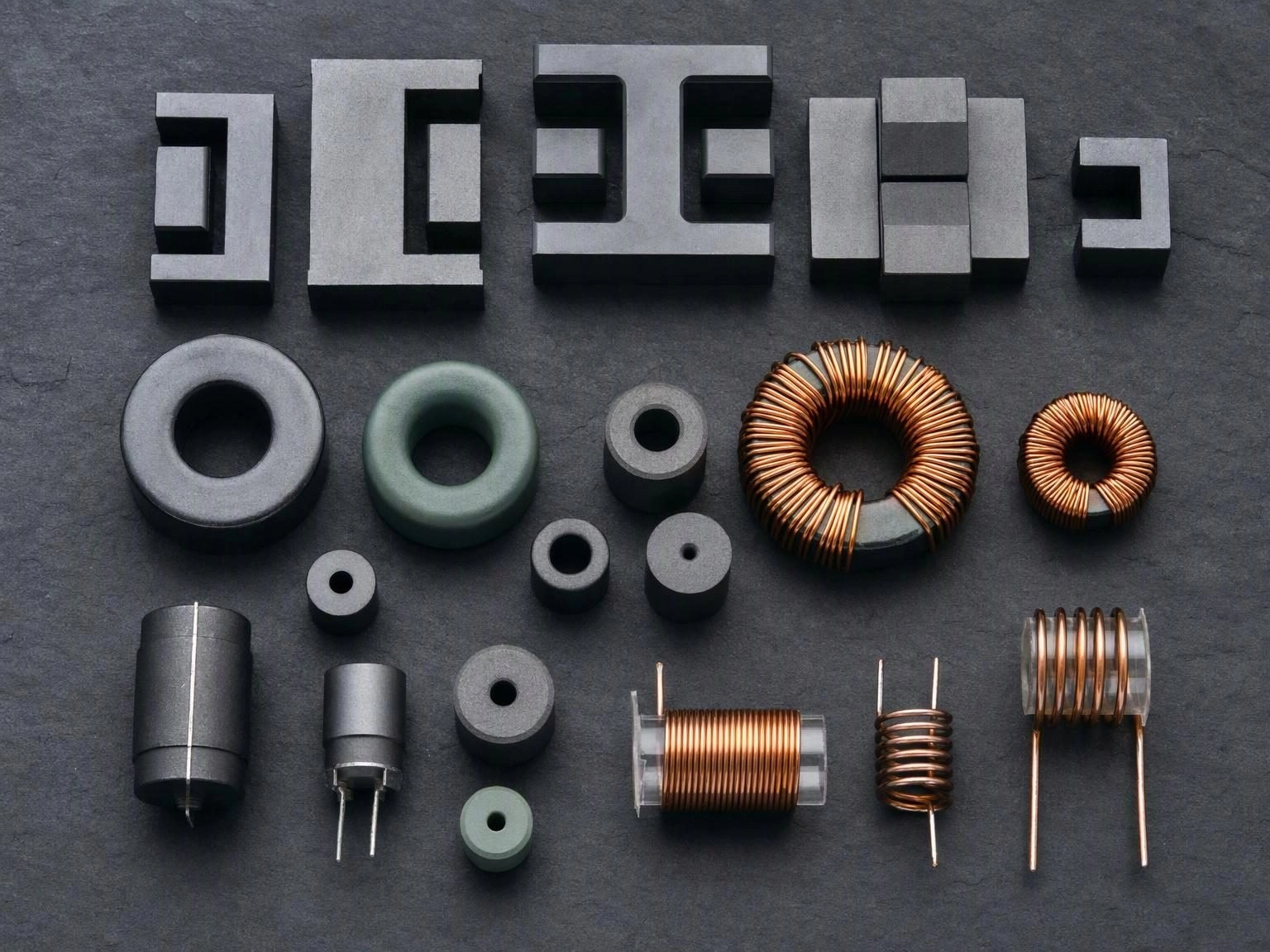
Powder cores distribute a microscopic air gap throughout the material, which gives them soft saturation behaviour. Inductance rolls off gradually with current instead of collapsing, and the core tolerates far higher DC bias than ungapped ferrite. The price is lower permeability, so more turns are required for a given inductance, and higher core loss, which limits their use at high frequency. Sendust, also sold as Kool Mu, sits between iron powder and ferrite, offering better loss than iron powder with better bias tolerance than ferrite.
- MnZn ferrite for high permeability and low loss where bias is modest
- Iron powder for the lowest cost where soft saturation and loose tolerance are acceptable
- Sendust for a balance of low loss and DC bias tolerance in power inductors
- Nanocrystalline and amorphous for high permeability with low loss and good thermal stability
- Air core where saturation must be impossible and very high frequency linearity is required
Nanocrystalline and Amorphous
Nanocrystalline cores deliver very high permeability with low loss and unusually stable performance across temperature, which makes them attractive for common mode chokes where a compact high impedance component is needed. Amorphous cores occupy a similar position for higher power applications. Both cost significantly more than ferrite, so they are reserved for cases where the performance gain justifies the price.
Air Core Inductors
An air core inductor cannot saturate because it has no magnetic material, and it behaves very linearly at high frequency with excellent quality factor. Its inductance per unit volume is poor, so it is bulky, and its open magnetic path radiates flux freely. It earns its place in RF circuits, matching networks and applications where saturation is structurally unacceptable rather than in general power conversion.
Matching Material to Application
Start from the current waveform. A pure AC application with modest bias points to ferrite. A large DC component points to a powder or gapped core. A requirement for high impedance in a small volume at elevated temperature points to nanocrystalline. A demand for perfect linearity at high frequency points to air. Working from the waveform rather than from an existing bill of materials is what produces a design that survives its first thermal and EMC test.
We produce inductors across these material families, and can advise on the trade off between size, loss and cost for a specific current waveform.