
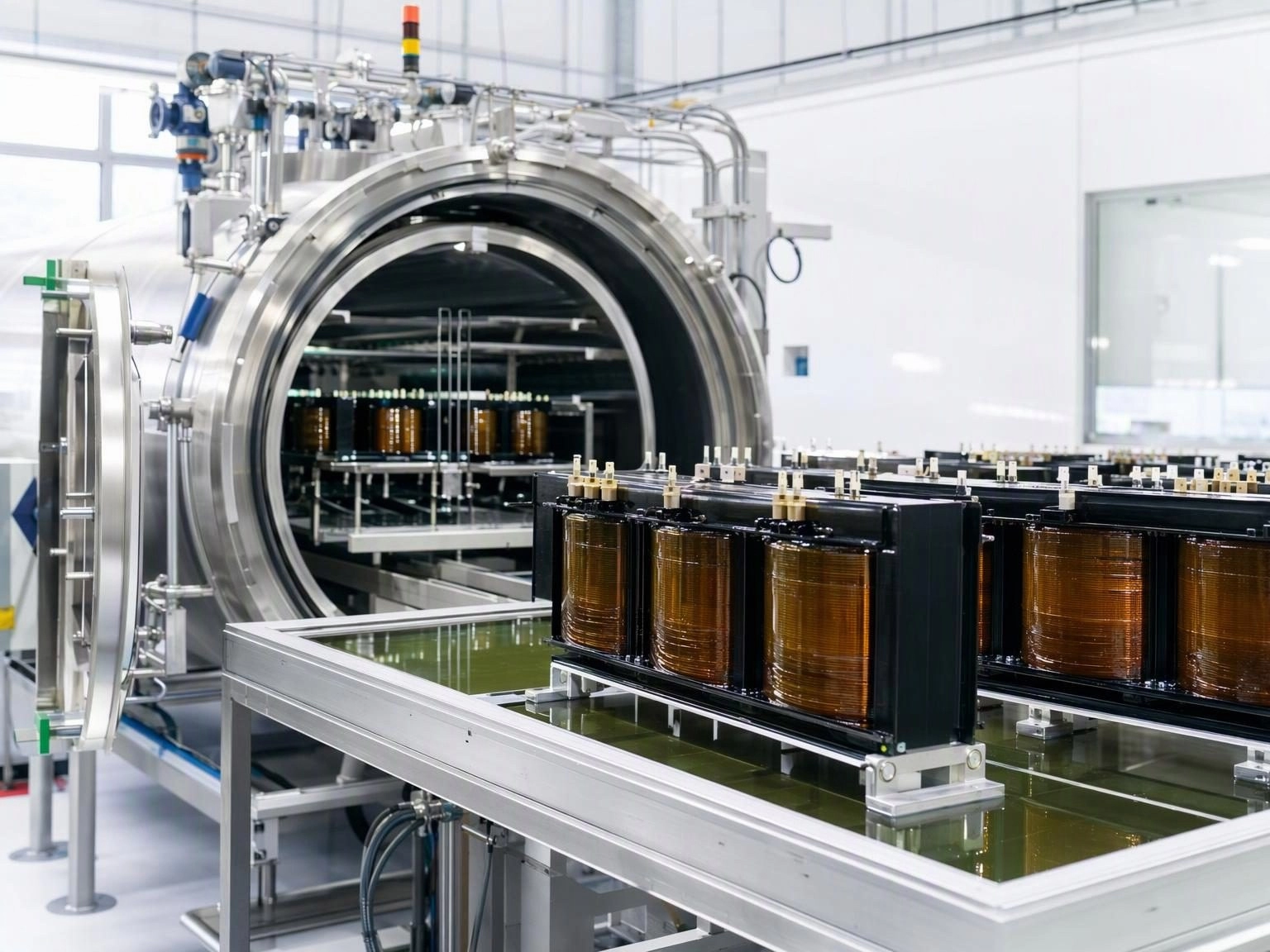
What Vacuum Impregnation Does
Vacuum impregnation draws varnish into the winding while the assembly is held under reduced pressure, then releases the vacuum so that atmospheric pressure forces the varnish into the spaces between turns, layers and the bobbin. The component is then baked to cure the varnish. The result is a winding that is mechanically locked in place rather than one that merely holds its shape by wire stiffness and solder terminations.
Mechanical Fixation and Noise
An unimpregnated winding can move. Under vibration or thermal cycling, turns shift slightly, and in an inductor or transformer carrying ripple current, that movement produces audible noise at the switching frequency or its harmonics. Beyond the annoyance, movement abrades the wire enamel and eventually creates an inter turn short. Impregnation eliminates the movement at its source, which is why transformers intended for automotive, industrial and appliance applications almost always specify it.
Dielectric Strength Between Layers
Varnish fills the microscopic voids between turns and between layers. Those voids are where partial discharge begins under high voltage stress, particularly in the gaps between a high voltage winding and its neighbours. By filling them, impregnation removes the sites where the insulation system is weakest and raises the effective dielectric strength of the whole assembly.
- Eliminates winding movement under vibration and thermal cycling
- Suppresses audible noise at the switching frequency
- Raises dielectric strength by filling voids between turns and layers
- Improves resistance to moisture and airborne contamination
- Provides a degree of mechanical protection to the wire enamel
Moisture and Contamination Resistance
An open winding acts as a filter for humidity and airborne contaminants drawn in by thermal cycling. Varnish seals the winding surface and reduces the rate at which moisture reaches the insulation, which matters wherever the end product operates in humid, outdoor or industrial environments. It also reduces the risk of electrochemical migration between closely spaced conductors under humid conditions.
Why the Baking Step Cannot Be Rushed
Curing is where the varnish acquires its final mechanical and electrical properties. An undercured component feels dry but remains soft, loses its fixation benefit and can release volatiles inside a sealed enclosure. Cure schedules are specified in terms of time and temperature, and the actual winding temperature during baking, not the oven air temperature, is what determines the result. Large cores need longer schedules because heat reaches the winding more slowly.
Where It Fits in the Process
Vacuum impregnation and baking sit between electrical testing and final inspection. A component should already have passed its electrical tests before impregnation, so that varnish is not wasted on a defective unit, and it must pass high potential and appearance inspection afterwards, because the impregnation step is also where handling damage can occur.
Our production line includes vacuum impregnation and controlled baking between electrical testing and final high potential inspection, with the cure schedule matched to the core size and the insulation class of each product family.