
Repeatability Is the Real Gain
The most visible effect of automatic winding is reduced labour cost, but the more valuable effect is repeatability. A manual winding operation produces a slightly different result every time. Turn placement shifts, tension varies, layers stack unevenly. Those variations show up as differences in leakage inductance, interwinding capacitance and DC resistance between units of the same part number, and they become a design margin problem for the customer.
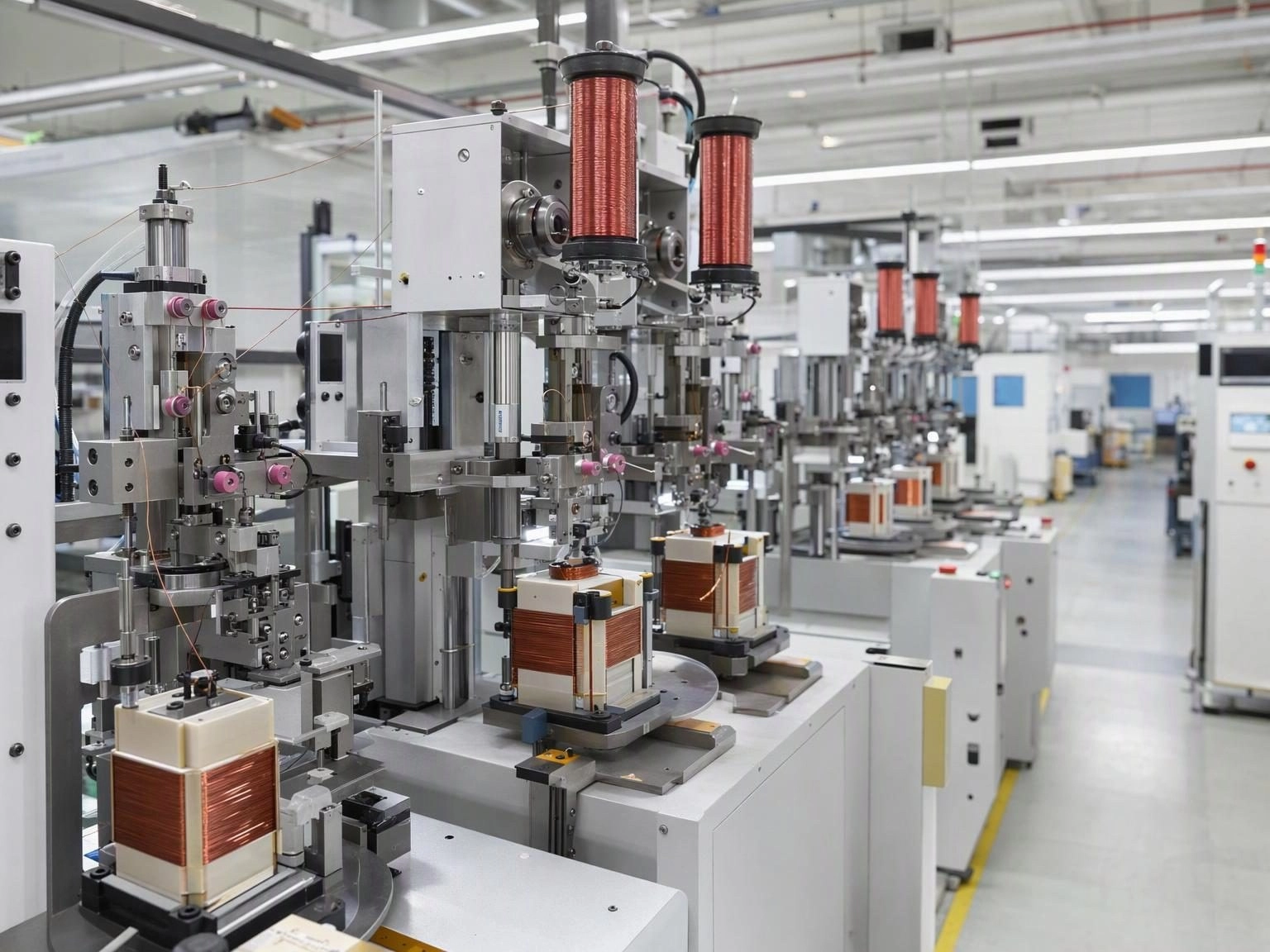
A CNC winding machine reproduces the same program on every unit, so the electrical parameters that depend on winding geometry become a controlled characteristic rather than a statistical one.
Tension Control Protects the Wire
Winding tension is a surprisingly critical parameter. Too little tension and the winding is loose, which raises leakage inductance, permits movement under vibration and can resonate audibly. Too much tension and the enamel is damaged, insulation resistance falls and a latent short is created that may only appear after thermal cycling. Automatic machines apply and monitor tension continuously, which removes the single largest source of variation in manual production.
Layering and Fill Factor
How turns are distributed within the winding window affects nearly everything. A tight layered winding reduces leakage inductance but raises interwinding capacitance, which is a disadvantage in high frequency applications. A bank or random winding does the opposite. A machine can reproduce a specified layer pattern exactly, which means the designer can choose the pattern deliberately rather than accepting whatever a manual operator produces.
- Layered winding for low leakage inductance and predictable parameters
- Bank or random winding for lower capacitance at high frequency
- Sectioned winding for high voltage isolation between sections
- Interleaved primary and secondary for very low leakage inductance
Where Automation Still Needs People
Automatic winding handles the winding operation itself extremely well, but several adjacent steps remain difficult to automate economically. Loading and unloading small bobbins, terminating fine wire onto small pins, taping barriers, assembling cores and performing final inspection all involve handling that varies by part design. In practice a modern line combines automatic winding with semi automatic termination and manual assembly, with the automatic stage providing the consistency and the manual stages providing the flexibility.
What It Means for a Customer
The practical consequence for a buyer is that automatic winding makes tight tolerance and lot to lot consistency achievable at volume, and it makes complex winding patterns economically viable on small components where manual production would be too slow or too variable. It also makes the winding specification meaningful. When a supplier quotes a leakage inductance tolerance, an automated line is what allows that tolerance to be held in production rather than only in the sample.
Our production uses fully automatic CNC winding machines alongside automatic test equipment, which together support consistent electrical parameters across production lots and provide the measurement records that back a tight specification.