
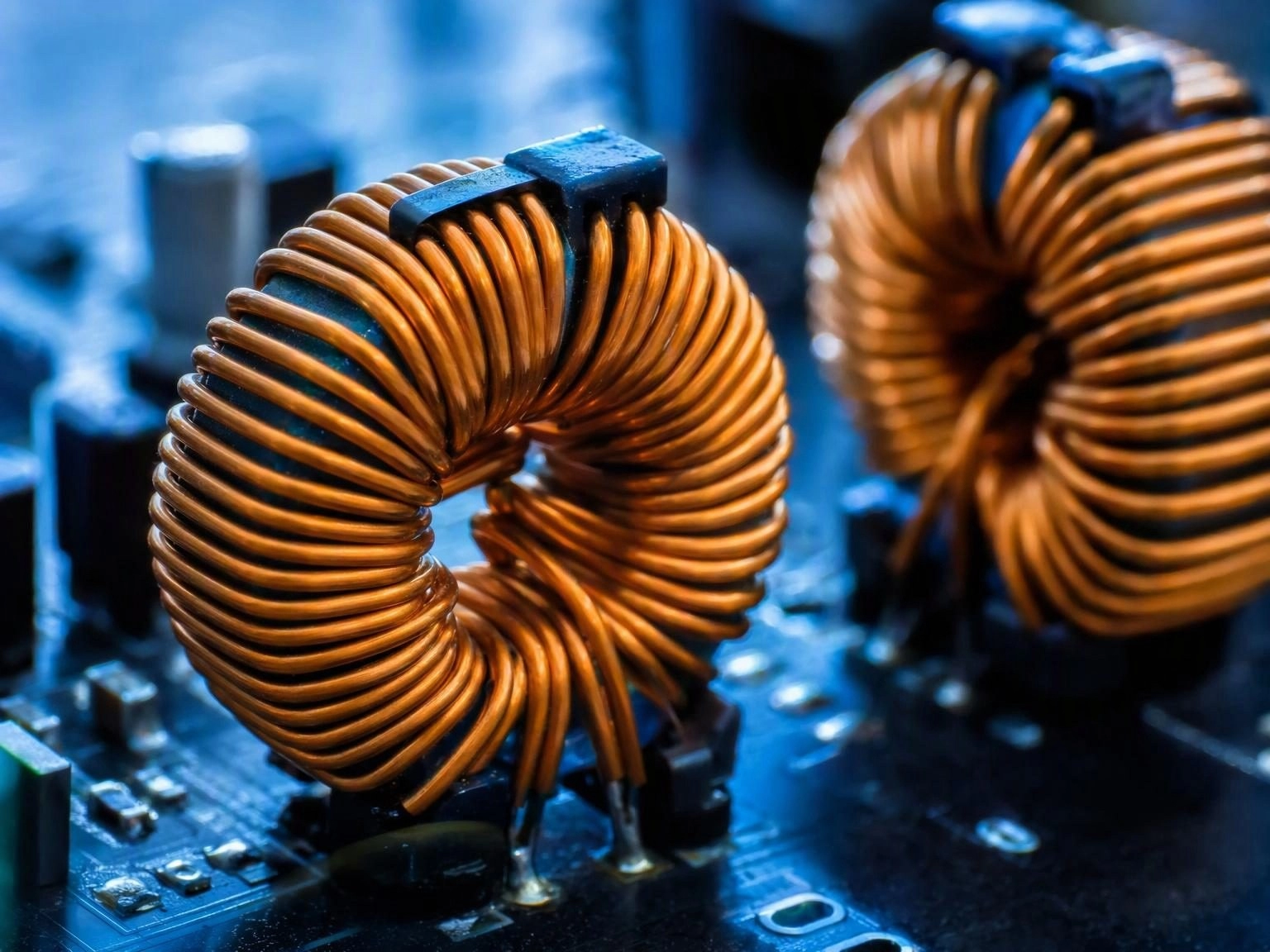
What a Common Mode Choke Actually Does
A common mode choke places two windings on a single core so that differential current flowing in one direction through the first winding and back through the second produces opposing flux that cancels. The choke therefore presents almost no impedance to the power current it is meant to pass, while common mode noise currents, which travel in the same direction on both lines, see the full inductance of the winding.
That asymmetry is the entire point. The device is a filter that discriminates by current direction rather than by frequency alone.
Impedance Is Frequency Dependent and Rarely Flat
A choke is usually specified by its impedance at a reference frequency, commonly 100 kHz or 1 MHz, but the number only tells part of the story. Impedance rises with frequency up to a peak set by the core material and the winding self capacitance, then falls away as parasitic capacitance provides a bypass path. A choke with impressive impedance at 1 MHz may be nearly transparent at 30 MHz, exactly where many radiated emissions problems live.
This is why the same nominal inductance can behave very differently between two suppliers, and why a datasheet curve matters more than a single headline figure.
Leakage Inductance Is a Feature Not a Flaw
No common mode choke is perfectly coupled. The residual differential inductance, usually a fraction of a percent to a few percent of the common mode value, provides useful differential mode filtering. Some designers deliberately specify a controlled leakage inductance to suppress differential noise in the same component and reduce part count. Others need it minimised so it does not attenuate the signal they intend to pass.
Either way, the value should be specified rather than left to chance.
Core Material Sets the Frequency Window
Manganese zinc ferrite is the workhorse for common mode chokes because of its high permeability and reasonable cost. Nanocrystalline cores offer substantially higher permeability and better performance at elevated temperature, which allows a smaller core for the same impedance, at a higher price. Iron powder and sendust cores appear where DC bias or high saturation margin is required.
- MnZn ferrite for general purpose EMI filtering at moderate cost
- Nanocrystalline for high impedance in a small volume with stable performance at temperature
- Iron powder and sendust where DC bias tolerance matters more than raw impedance
- Toroidal construction for low leakage and compact wound assemblies
Practical Specification Checklist
State the frequency band you must attenuate, the rated current including any inrush, the maximum allowable leakage inductance if you also rely on differential filtering, the operating temperature range and the safety insulation requirement between windings. With those five inputs a choke can be selected with confidence rather than by copying a competitor bill of materials.
We produce toroidal and UU style common mode chokes wound on MnZn ferrite and nanocrystalline cores, with impedance values and leakage inductance held to the specification agreed during sampling.